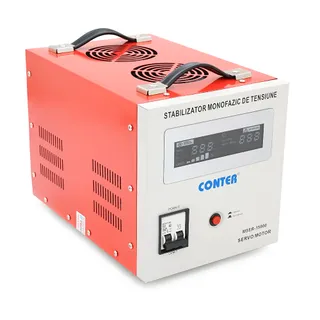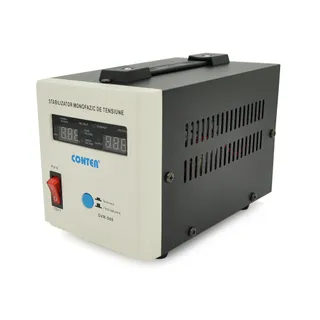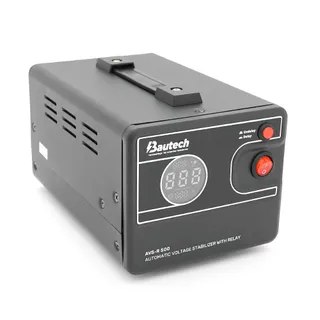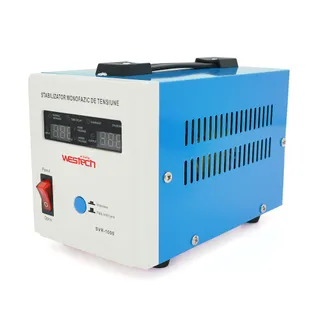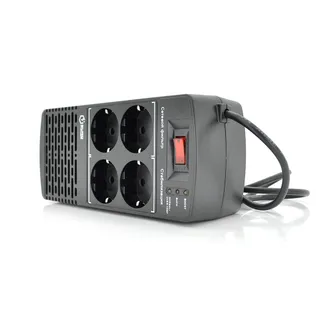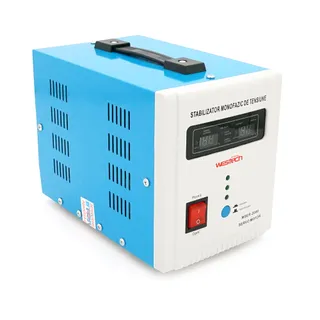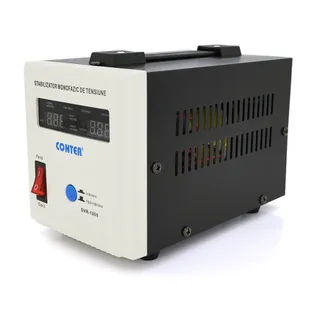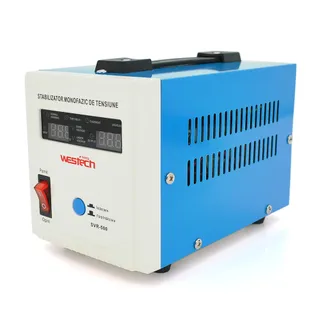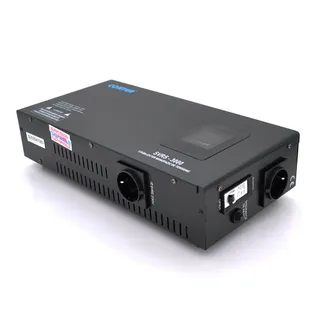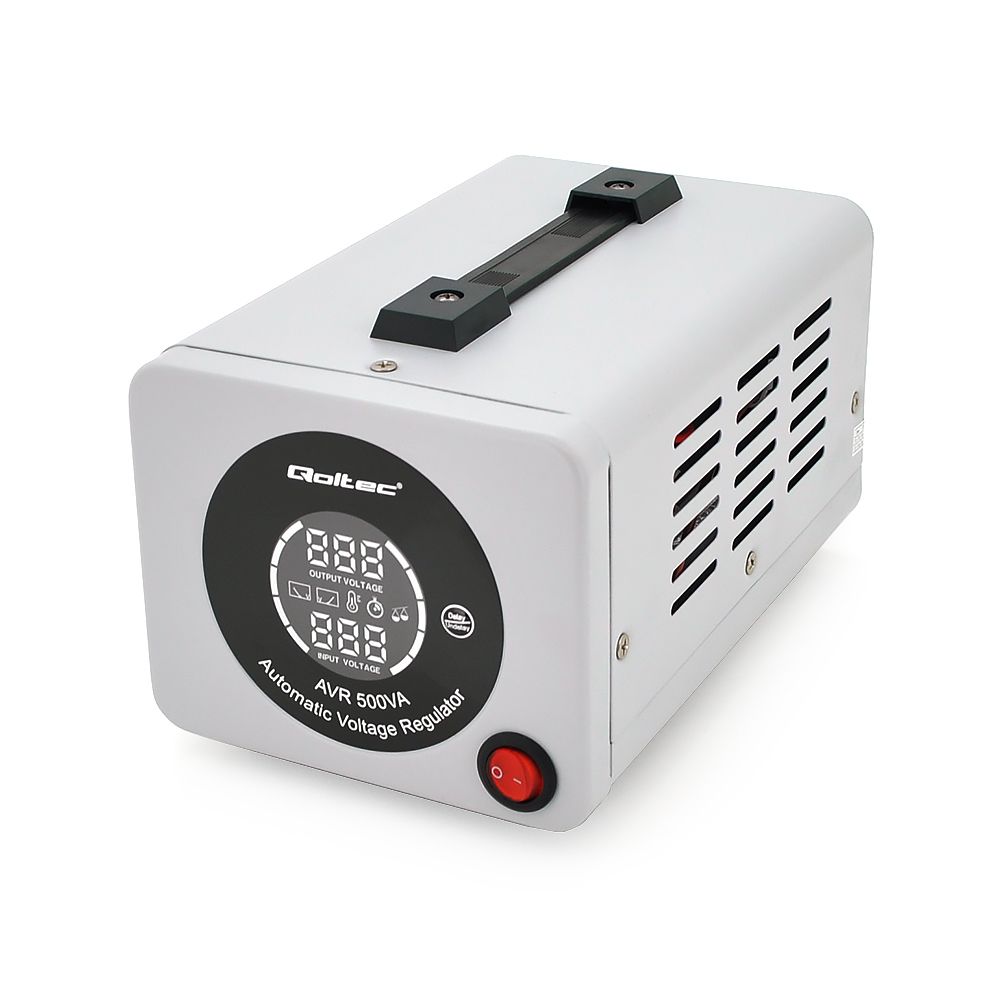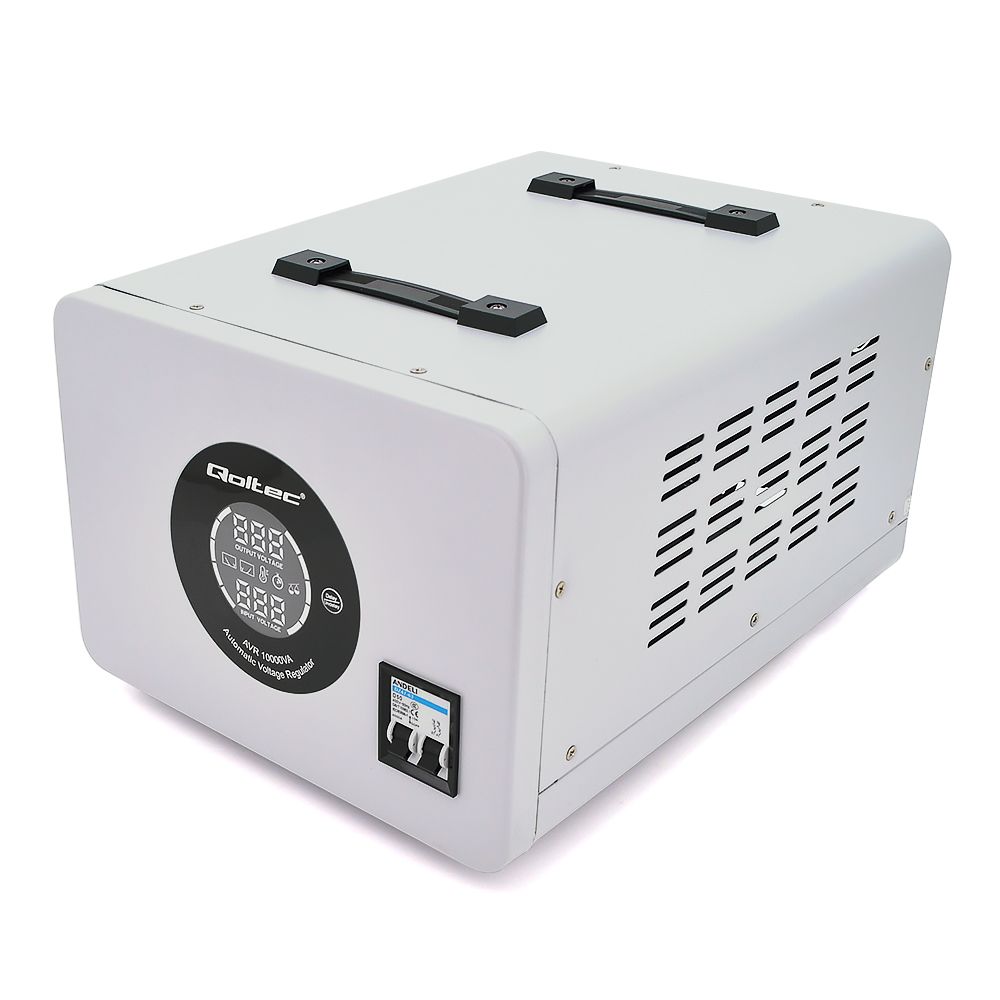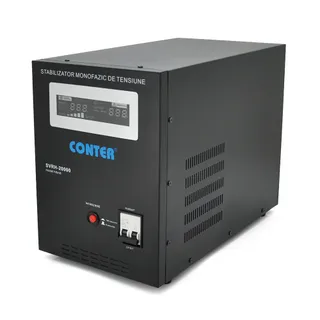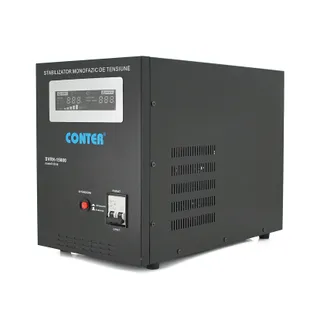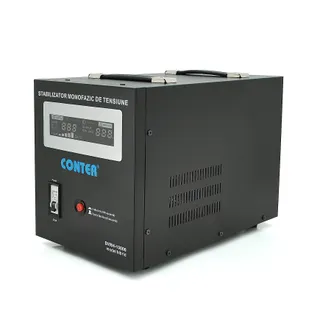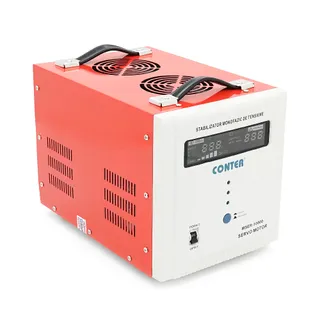
Voltage stabilizer Conter MSER 10000 VA-V2/7500W single-phase
Conter
17,000 ₴
 1 / 5
SKU 18389
The proposed high-quality power supply is created on the principle of digital-to-analog conversion based on the method of summing analog values proportional to the weights of the digital code bits, the bit coefficients of which are equal to one.
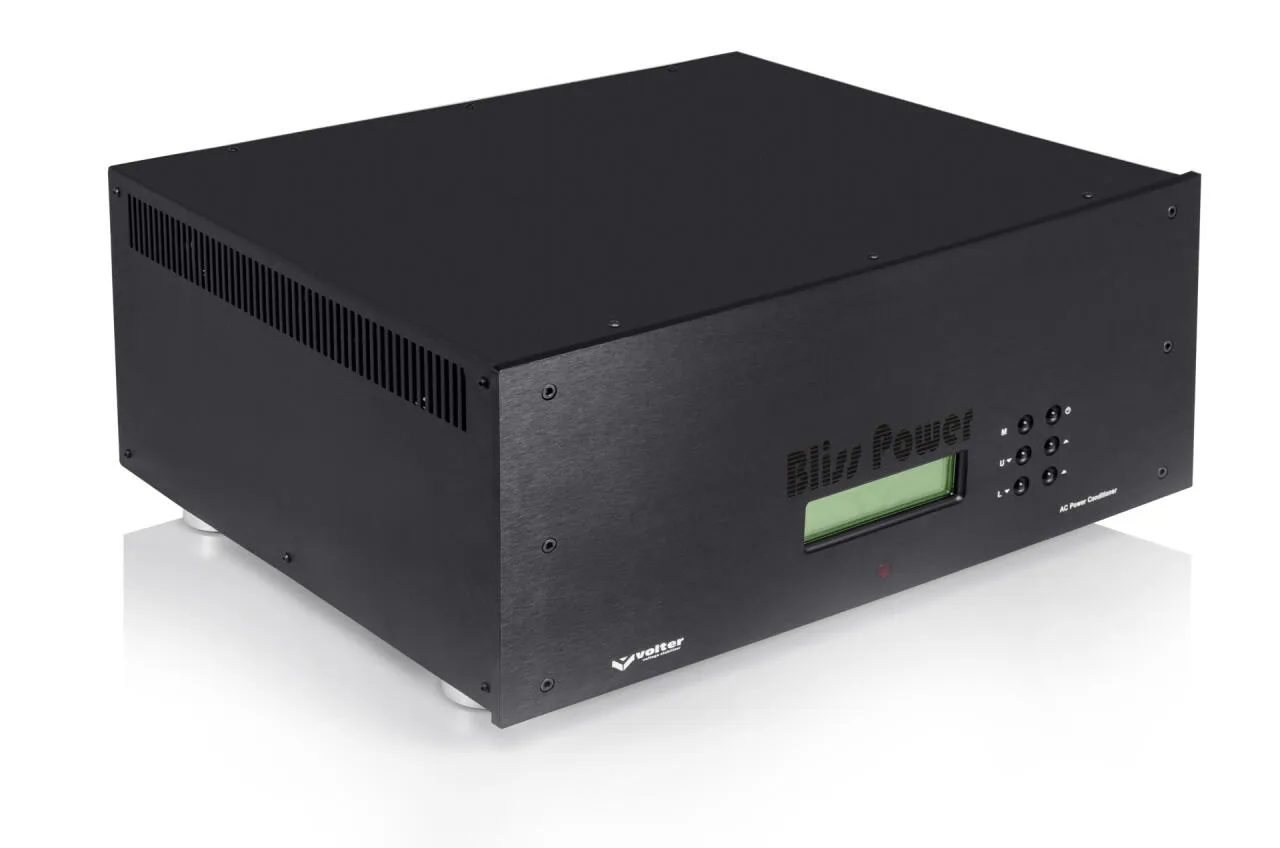
How was the BlissPower voltage regenerator developed by Volter TM?
Several years ago, the technical director of Electrosvit, an enterprise with vast experience in developing and manufacturing devices that improve voltage quality, set the company's developers the task of creating a fundamentally new device for the company — a voltage regenerator.
The difference between mains voltage regenerators and key-type actual mains voltage stabilizers and uninterruptible power supplies based on inverters is as follows: the regenerator generates an output signal with a waveform close to an ideal sine wave with minimal harmonic distortion, in the absence of high-frequency interference. It not only stabilizes the output signal voltage by its effective value, but also ensures its regulation within wide limits in amplitude and frequency.
In fact, the regenerator provides the equipment with autonomous power supply, not connected to the mains voltage. In addition, taking into account the capacitive nature of the regenerator's load, it must have a high overload capacity, providing significant power when turning on the equipment.
The main areas of application of regenerators are precision equipment, primarily high-quality sound reproduction systems, metrological and medical equipment.
The group of regenerator developers included the technical director of Electromir and two chief designers of electrical engineering enterprises who have many years of experience in developing conversion and measuring equipment, and are authors of dozens of inventions.
In the technical specification for the development of the regenerator, PS Audio regenerator was chosen as a prototype and target product in terms of parameters, the technical solution of which is protected by patent US 7,259,705 dated August 21, 2007. The PS Audio regenerator is built on the basis of a high-quality sine wave generator. Such an implementation principle ensures all requirements for the accuracy of the output signal, but the class AB low-frequency amplifier has a low efficiency — no more than 30 - 40%. An increase in efficiency, i.e., moving the operating mode to class B, leads to a significant increase in harmonic distortion. Therefore, it is almost impossible to make a high-power device using this principle –
at a rated load power of 1 – 2 kW, the dissipated power would be 2.5 – 5 kW.
When choosing a technical solution, a number of options were considered and put aside. For example, a resonant converter, which provides an ideally sinusoidal output signal waveform, but does not allow regulating it in either amplitude or frequency. Inverter options are completely unacceptable for highly sensitive audio equipment due to the high level of interference, both radio frequency and generated by the inverter into the power grid. A promising variant of the technical solution consisting in the formation of an in-phase tracking low-frequency amplifier power supply with a sinusoidal signal was also considered.
Actually, this solution served as the impetus for searching for an option that meets all the requirements of the technical specifications.
The optimal option providing both high efficiency and output signal quality requirements turned out to be the implementation of a regenerator based on a powerful digital-to-analog converter. The proposed technical solution provides an efficiency of the device of more than 80%, which is due to minimal losses in the digital-to-analog converter switches and insignificant losses. The significant efficiency of the device made it possible to make it with a large design margin to ensure high reliability of the device. Deep feedback provides a virtually zero output impedance and, consequently, ensures ideal operation of the regenerator for a non-stationary load with an arbitrary impedance. Despite the relatively low power in the 1100 W mode, the device provides starting currents of the order of 50 A, which guarantees the inclusion of a large capacitive load, for example, power amplifiers with huge capacitors in the power supply circuits. Power is supplied from a multi-winding mains transformer, which provides galvanic isolation from the mains and minimizes common-mode interference. The product development took over five years. During this time, several working prototypes were manufactured, experimental verification of all technical solutions was carried out, and a technological and maintainable product design was developed.
When testing the regenerator prototypes, the stability of its operation was tested on virtually any load – active, electric motor, welding transformer, a set of fluorescent lamps, and the capacitive load most characteristic of modern equipment. Naturally, its operation as a power source for audio equipment of various topologies with both transistor and tube power amplifiers was also tested.
The quality of the output signal was evaluated quantitatively by the stability of the output voltage under fluctuations of both mains voltage and load parameters, by the total harmonic distortion factor, and during operation in overload modes typical when turning on equipment and reproducing an audio signal at maximum power.
The originality of the proposed technical solution is confirmed by patents of Ukraine No. 91548, No. 107895 and Russia No. 150730 and No. 2549166 and the priority certificate PCT/
The regenerator contains 7 DC power sources, the voltage values of which relate as U-2U (similar to a resistive matrix in solid-state DACs). High-speed field-effect transistor switches are used to control the voltage generation process.
Thus, every 100 microseconds, a part of the sine wave is assembled from the voltage sources according to the task of the digital reference in the microprocessor. Consequently, we have a power digital-to-analog converter that builds its output signal directly on the load without intermediate conversions and without pulse-width modulation (not to be confused with a class D amplifier). Harmonic distortion of the output signal is no more than 0.1%.
This approach allows achieving high efficiency – up to 80%. At the same time, the device has a rather low output impedance (lower than the mains), since the capacitances of the filtering power sources are tens of thousands of microfarads on each source, and the resistance of the field-effect transistors connecting the sources is measured in tens of mOhm, and inductive resistance is practically absent.
An important advantage is that the device is simultaneously a voltage stabilizer in the range from 190 to 255 V with an output power of 1.1 kW with complete galvanic isolation from the mains. Hz.
The beneficial effect on sound when increasing the supply frequency was proven by PSAUDIO when it began producing its famous line of regenerators with the same function.
Dispatch to post branches, parcel lockers, or by courier to your doorstep. All packages are insured for 100% of value. Delivery time: 1–3 business days.
Flexible options: Cash on delivery at Nova Poshta branch or bank transfer invoice (IBAN) for individuals, FOP and companies.